 David McGuffin's Exploring Europe
Munich
Destination guide
Oktoberfest 2027 edition
The Capital of the Wittelsbach Kings, Bavaria, Germany
David McGuffin's Exploring Europe
Destination guide
Oktoberfest 2027 edition
The Capital of the Wittelsbach Kings, Bavaria, Germany
Oktoberfest 2027 runs from Saturday, September 18 to Sunday, October 3, 2027, on Munich's Theresienwiese. If you've ever wanted to raise a one-liter stein in a tent full of 6,000 new friends, this is the year to plan it. But here's my advice: don't let the beer tents be the whole trip. Munich is a royal city with lots of history, great churches, leafy parks, and a beer culture that goes back to the monks who founded the place. This guide covers it all.
Munich is the capital of Bavaria, a city of about 1.6 million people that's small enough to enjoy on foot yet big enough to have everything you need. It sits on the Isar River, with the Alps close enough to see from the top of a church tower on a clear day.
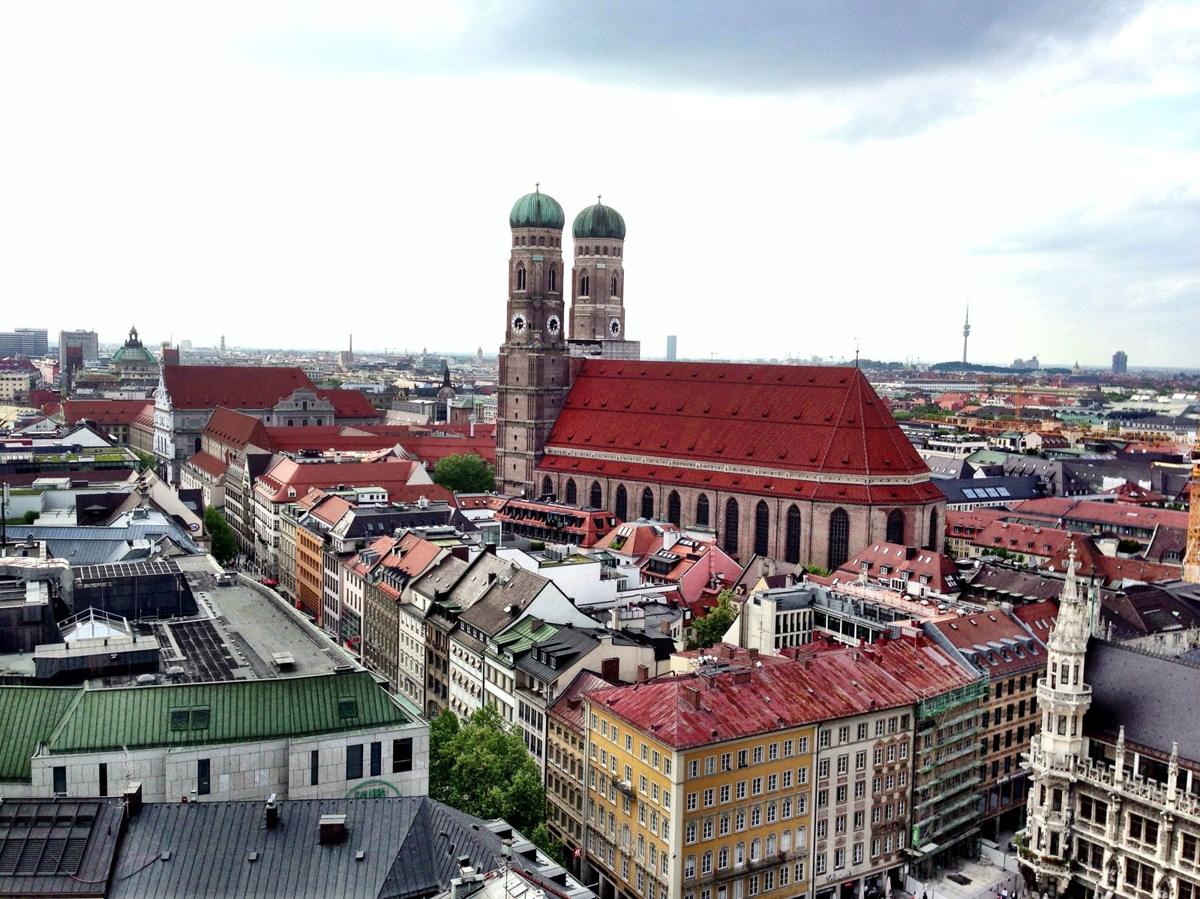
So where did the name come from? In the 12th century, a little community of monks lived on a hill where St. Peter's Church stands today. The settlement took its name from them: München means "of the monks." You'll see one of them everywhere you go. The Münchner Kindl, a little figure in a black monk's robe holding a red book, is the city's coat of arms, and it shows up on buses, posters, beer mugs, and the very top of the New Town Hall's spire.
The monks' town made its money on salt, which was as good as gold for preserving food. Then, in 1158, a Bavarian duke named Henry the Lion built a toll bridge over the Isar and diverted the salt trade from Salzburg to Augsburg right through the market square. He added walls and towers and opened a market, and country folk poured into town on market day. That's why we traditionally say Munich was founded in 1158.
In 1180, the Wittelsbach family took control of Bavaria, and they held on for 738 years, until 1918. One of them, Ludwig the Bavarian, was elected Holy Roman Emperor in the 1300s and gave Munich a monopoly on the salt trade. During the Reformation, northern Germany followed Martin Luther, but Bavaria stuck firmly with the Pope. That's why Munich's churches look so Italian — and why the city ended up with more saints' relics than anywhere except Rome.
The 17th century was a rough time for Munich. Religious wars and plague left the city poor and overshadowed by the Habsburgs in Vienna. Then in the 1800s, Napoleon swept through Bavaria, and most of Europe. He made the Wittelsbach duke, Max Joseph, King of Bavaria in 1806, and Max and his successors, Ludwig I and Ludwig II, rebuilt Munich as a grand neoclassical capital of wide boulevards, columns, and monuments. Bavaria joined a unified Germany in 1871, and Berlin, not Munich, became the capital.
But the 1900s were not so good to Munich and all of Germany. After World War I, Munich fell into political chaos, and in that chaos Adolf Hitler's Nazi party took root. Munich later called itself the "Capital of the Movement." Allied bombing in 1944 and 1945 destroyed most of the historic center. Here's something most visitors never notice: approaching Munich from the north, you'll see grassy hills about 150 feet high laced with bike trails. They're made of rubble from the bombed city. Every time I see them, I think about the toll war takes on everyone.
After the war, Munich chose to rebuild much of its old center in the original style, brick by brick, using pre-war photographs as a guide. The 1972 Summer Olympics gave the city another facelift: new subway lines, and one of Europe's first pedestrian zones through the heart of the old town. Sadly, those Games are also remembered for the terrorist attack that killed eleven Israeli team members. Today, Munich is one of Germany's wealthiest, safest, and most livable cities — and every fall, it throws the biggest party on earth.
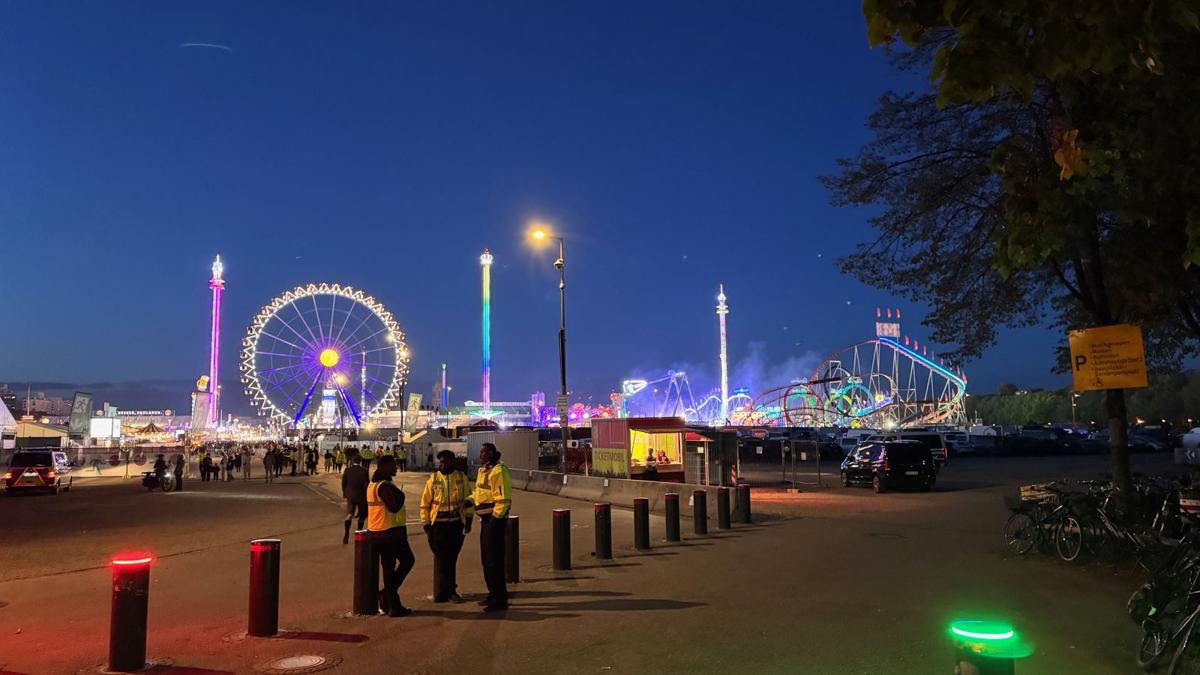
The 192nd Oktoberfest runs 16 days, from Saturday, September 18 to Sunday, October 3, 2027. Why is a festival called Oktoberfest mostly held in September? It started in October, but over the years the opening was moved earlier to catch the warmer evenings. The rule today: it opens the Saturday after September 15 and ends on the first Sunday in October, or on October 3 (German Unity Day) if that falls later.
| At a glance | Oktoberfest 2027 |
|---|---|
| Dates | Sat, Sept 18 – Sun, Oct 3, 2027 |
| Where | Theresienwiese ("the Wiesn"), U-Bahn stop Theresienwiese |
| Admission | Free to the grounds and the beer tents; small fee for the Oide Wiesn (€4 in 2026). |
| Opening | Keg tapping at 12:00 noon, Sept 18, in the Schottenhamel tent |
| Beer | Six Munich breweries only; €14.80–€15.90 per liter in 2026 (expect a bit more in 2027) |
| Tents | 14 large tents, 21 small tents, plus 3 at the Oide Wiesn |
In October 1810, Crown Prince Ludwig (later King Ludwig I) married Princess Therese of Saxony-Hildburghausen. The royal couple invited the people of Munich to a meadow just outside the city walls to celebrate, and the party wrapped up with a horse race. Everyone had such a good time that they did it again the next year, and the year after that. More than 200 years later, the meadow still carries the princess's name: the Theresienwiese. The locals just call it the Wiesn (VEE-zn), "the meadow."
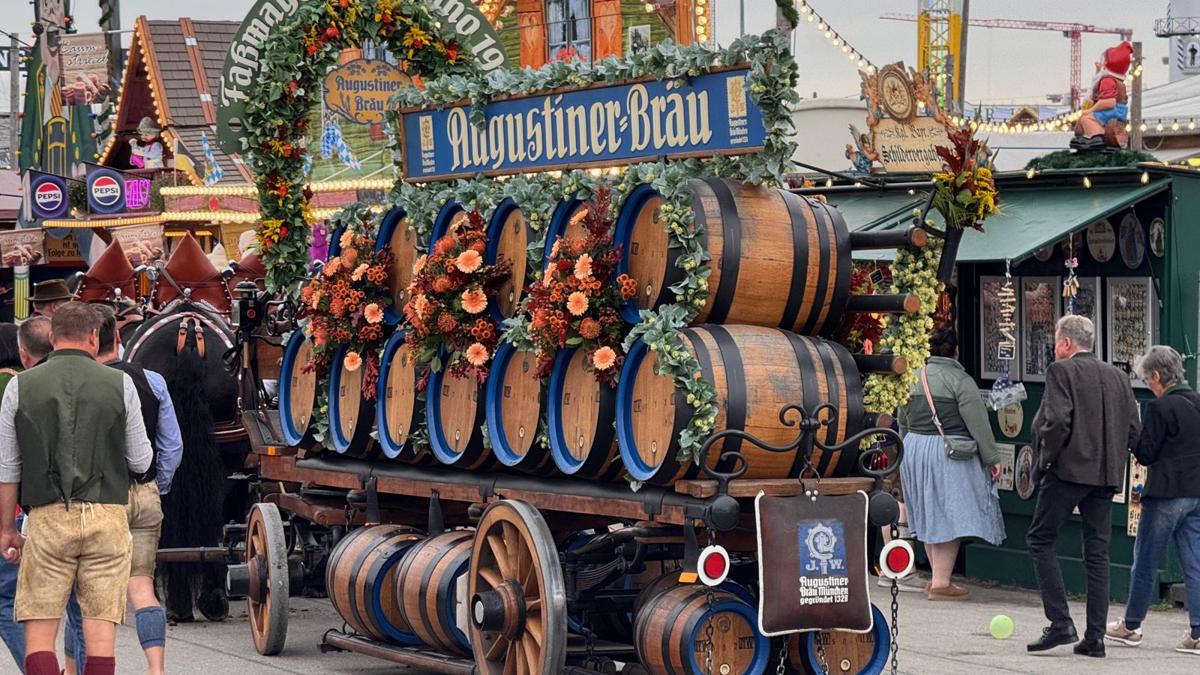
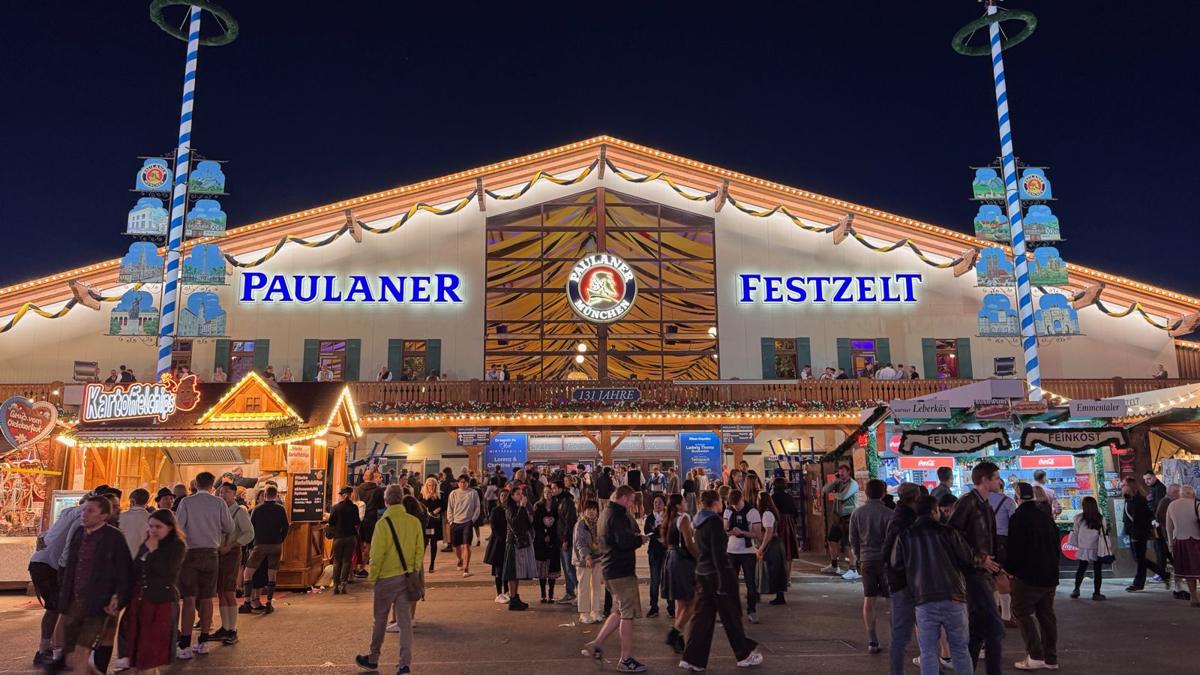
Forget everything you picture when you hear the word "tent." These are gigantic timber halls that take months to build, complete with balconies, bandstands, enormous facades, and industrial kitchens. The biggest of the tents hold several thousand people inside, with beer gardens outside. Each is run by a family host and pours beer from one of Munich's six big breweries: Augustiner, Hacker-Pschorr, Hofbräu, Löwenbräu, Paulaner, and Spaten. No other beer is allowed. Each tent has its own personality. The Hofbräu tent draws an international, party-hard crowd. The Augustiner-Festhalle is a local favorite, and the only one still tapping beer from wooden barrels. The Fischer-Vroni is famous for fish grilled on a stick, and the Ochsenbraterei has been roasting whole oxen since 1881.
Don't miss the Oide Wiesn (Old Wiesn) on the south end of the grounds. For a small admission fee, you get historic carousels, traditional brass bands, folk dancing, and a calmer, old-fashioned atmosphere. Beer is served in stone mugs. (U6 or U3: Poccistrasse).
The large tents open at 10:00 on weekdays and 9:00 on weekends and on October 3. Beer and music stop at 22:30, and the tents close at 23:30. Opening day is different. Tents open at 9:00, but there’s not a drop of beer poured until the Lord Mayor taps the first keg at noon in the Schottenhamel tent and shouts "O'zapft is!" — "It's tapped!" That morning, the festival hosts and brewery wagons, pulled by teams of draft horses, parade through the city to the grounds. On the first Sunday (September 19, 2027), thousands of marchers in traditional dress join the Costume and Riflemen's Parade. Both parades are free to watch from the curb.
Here's the deal. Entry to the tents is free, but tables are the hot commodity. Reservations are made only directly with each tent, and the evening and weekend slots are often gone months in advance. A reservation usually comes with vouchers for a liter or two of beer and half a roast chicken. Don't despair if you don't have one. Every tent keeps part of its seating unreserved. Go on a weekday, show up in the morning or early afternoon, and you'll usually find a spot. Once a tent is full, security closes the doors, and on weekend evenings that happens early.
Here's the good news: Munich's historic center is flat, compact, and made for walking. A ring road traces the line of the old city walls, and nearly every sight you'll want sits inside it. Four old gates, or Tore, make handy landmarks on a map: Karlstor near the train station, Isartor near the river, Sendlinger Tor to the south, and Odeonsplatz by the royal palace. Right in the middle is Marienplatz, and running east to west through it is the pedestrian zone of Neuhauser Strasse and Kaufingerstrasse. Get those in your head, and you'll never be lost for long.
For everything else, Munich's public transit network, the MVV, is clean, fast, and easy. The U-Bahn is the subway for getting around town. The S-Bahn is a commuter rail that runs underground through the center and out to the suburbs and the airport. Every S-Bahn line stops at both the Hauptbahnhof (main train station) and Marienplatz. Trams and buses fill in the rest. Taxis are expensive and rarely needed.
Being a country boy from Florida, I didn’t have any subways or public buses to ride. So, I didn’t even get to experience any public transportation until I first went to Europe (and Israel) in 1977. But, it wasn’t until the late 1980s that I took time to learn to ride the subway. I did that right here in Munich. I bought a day pass and spent the day riding the right train in the wrong direction and the wrong train in the right direction. Soon, I picked up the sequence of looking at the subway map, deciding where I wanted to go, and determining the correct direction by looking at the end of the line stop. Then, it got easier. Each line is color-coded and numbered, like U4 or S8. Find the line on the map, check the name of the last station in the direction you're going, and follow the signs.
| Ticket | Price | Good for |
|---|---|---|
| Single ticket (Einzelfahrt) | €4.20 | One trip in one direction, with transfers |
| Short trip (Kurzstrecke) | €2.10 | A short hop of a few stops |
| Single-Day Ticket (Single-Tageskarte) | €10.10 | Unlimited rides until 6:00 the next morning |
| Group Day Ticket (Gruppen-Tageskarte). This is a super value, but all group members must travel together. | €19.70 | Up to 5 adults traveling together, until 6:00 the next morning |
| Airport–City Day Ticket | €17.50 | The airport ride plus unlimited rides in town that day |
MVV usually adjusts its fares each January, so expect slightly higher prices in 2027. Buy tickets from the machines in the stations (they take coins, bills, cards, and contactless payment) or with the MVV or MVGO app. Tickets from the machines now generally come already validated, but if yours has no time and date printed on it, stamp it in the little validator box at the platform entrance before you ride. There are no turnstiles, but plainclothes inspectors do check, and the fine is steep. My best advice? If you'll ride three or more times in a day, the day ticket pays for itself. Traveling as a couple or a family? The Group Day Ticket is a bargain. From 2026, children 6 to 14 ride free with an adult's Single-Day Ticket.
The Theresienwiese is a short walk southwest of the old town. The U4 and U5 stop right at the grounds (Theresienwiese station), but it gets jam-packed and is sometimes closed for crowd control. Goetheplatz (U3, U6) and Schwanthalerhöhe (U4, U5) are good alternatives. Or simply walk from the Hauptbahnhof in about 15 minutes. Fun fact: the rest of the year, the Wiesn is a vast, empty, paved lot. On my first visit, I hopped off the U-Bahn expecting beer tents and found a 100-acre empty lot without a tent in sight!
Munich Airport (MUC) is about 25 miles northeast of the city. The S1 and S8 S-Bahn lines run to the Hauptbahnhof and Marienplatz in about 40 minutes. The Hauptbahnhof is the city's rail hub, with direct trains to Salzburg, Vienna, Zurich, Innsbruck, and beyond. If you're arriving by car, don't drive into the old town. Park at your hotel or a public garage and leave the car until you go.
Here's the old town at a glance. Tap any place in the key to jump to its part of the guide.
I've led this walk more times than I can count, and I still find something new every time. It starts at Marienplatz, winds through the markets, churches, and shopping streets of the old town, and ends, appropriately enough, at the Hofbräuhaus. Allow about three hours, longer if you stop for a beer (and you should!). It's flat the whole way.
Before we start, keep this in mind. Much of Munich was heavily bombed during World War II, and most of what you see in the historic center has been carefully reconstructed in its original style since the late 1940s. So that medieval-looking building may only be 70 years old! Inside many of the churches, look for the old black-and-white photos of the wartime damage. They tell the story better than I can.
Stand in the middle of the square and look up at the golden statue on the tall column. That's Mary, the mother of Jesus, and the namesake of this square. The statue was cast around 1590, and the column went up in 1638, smack in the middle of the religious squabbles of the Reformation and the Thirty Years' War. Back then, Munich and Bavaria were on the front lines against the Protestant movement led by Martin Luther up north. Now look at the four corners of the base and notice the little cherubs fighting four beasts, each one a disaster the city feared most. The lion is war, the dragon is hunger, the basilisk (that creature with a rooster's head) is plague, and the serpent is heresy. And heresy? Back then, that meant the Protestants!
Look up and find the façade of the big, gray, ancient-looking building with the spire soaring 280 feet above the square. This is the New Town Hall, or Neues Rathaus. Although it looks really old, it was actually built between 1867 and 1908, in a style called neo-Gothic. Notice the statues on the façade. Many think they're medieval saints, but they're actually Bavarian dukes, kings, and nobles. By the way, the New Town Hall survived the bombs, and it served as the United States military headquarters after the Americans liberated Munich in 1945.
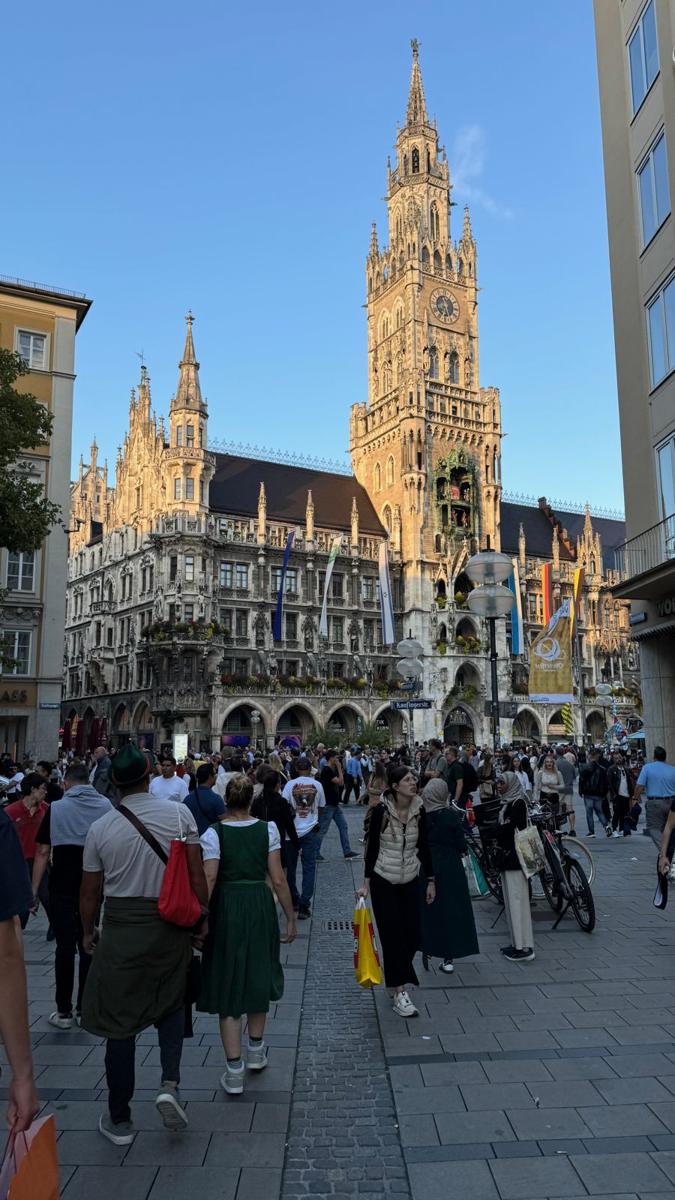
The New Town Hall is famous for its Glockenspiel. Daily at 11:00 and 12:00 noon (and at 17:00 from March through October), a carillon in the tower rings out a tune while little figurines come out on the balconies and spin and dance around. The show tells the story of a noble wedding that took place in Munich in 1568. You'll see the wedding procession, a jousting match with knights on horseback, and, down below, the dancing barrel makers. Legend says the coopers first danced in the streets to coax folks back out of their homes after a plague.
Now look way up, to the very top of the steeple. See the statue of a child with outstretched arms? He's dressed in a monk's robe and holds a book in his left hand. This is the Münchner Kindl, the Munich Child, and the symbol of the city. You'll spot this little monk all over town on posters, coats of arms, buses, and beer mugs. If you'd like a great view of the city, ride the elevator to the top of the tower for a small fee. The entrance is inside the courtyard.
Face the New Town Hall and look to the right. That white building with the Gothic spires is the Old Town Hall, or Altes Rathaus. Like most of the city center, it was heavily damaged in the war and rebuilt. Its tower now houses a fun little toy museum.
This is a good spot to get oriented. Still facing the New Town Hall? Straight ahead is north. To your left is the pedestrian shopping street, Kaufingerstrasse, which leads to the old city gate known as Karlstor, and beyond to the train station. To your right, passing by the Old Town Hall, the road leads to the Isartor gate and the Deutsches Museum.
St. Peter's Church is just over your right shoulder when you're facing the New Town Hall. It stands on the little hill where Munich's first settlers lived, and it's the oldest church in the city. Back in the 12th century, there was a monastery here. The town was tiny, and it got its name from the people who lived here, the monks, or München in German. The monks and townsfolk made their money selling salt, a valuable commodity for preserving food.
A bit later, Henry the Lion, a Bavarian duke, took over and built a toll bridge over the Isar River to tax the salt trade. He added city walls and towers and opened the market, and people came from all over the countryside on market day. Marienplatz became the town center, right at the crossroads of the Salt Road running from Salzburg to Augsburg. With all of Henry's improvements, we traditionally agree that Munich was founded in 1158.
Before you go in, notice the tombstones plastered onto the outside walls. They date from the 16th and 17th centuries. When the churchyard cemetery was dug up and moved in the early 1800s for hygienic reasons, a few of the old tombstones were set into the walls as a reminder.
Inside, you'll find old black-and-white photographs showing the damage here during World War II. The church was restored with private donations. Here's a story I love: after the war, the tower bells played a beloved Bavarian tune but stopped just before the last note. It was a not-so-subtle reminder to the locals that the church still needed money for the restoration! Mass is held here several times a day. If one is in progress, please stand quietly at the back, or better yet, come back later for a complete look around.
Now, find the second side chapel on the left. Yep, that's a skeleton in a glass box, dressed in jewels. The Latin inscription says this is St. Munditia, an early Christian martyr in Rome. She didn't die here in Munich, though. The Pope gave her remains to the city in 1675 as thanks for Bavaria's devoted service to the Catholic Church during the Reformation. In fact, Munich has more relics of saints than any other city except Rome! Farther in, look up at the ceiling fresco of Peter being crucified upside down. And don't miss the altar in the Gothic chapel to the left of the main altar. It's made of fragile sandstone, and it's original. The only reason it survived the war? It was buried in sandbags.
Feeling energetic? St. Peter's tower, nicknamed Alter Peter ("Old Peter"), has 306 steps and no elevator. It costs about €5, and the entrance is around the side of the church. The view of the city center, the twin domes of the Frauenkirche, and, on a clear day, the distant Alps is worth every step.
Exit St. Peter's and go to the right. You'll come to a balcony overlooking an outdoor market. Head on down the staircase. This is the Viktualienmarkt, a busy mix of produce stands, flower stalls, and outdoor eateries. There has been a market on this spot since the days of the salt crossroads.
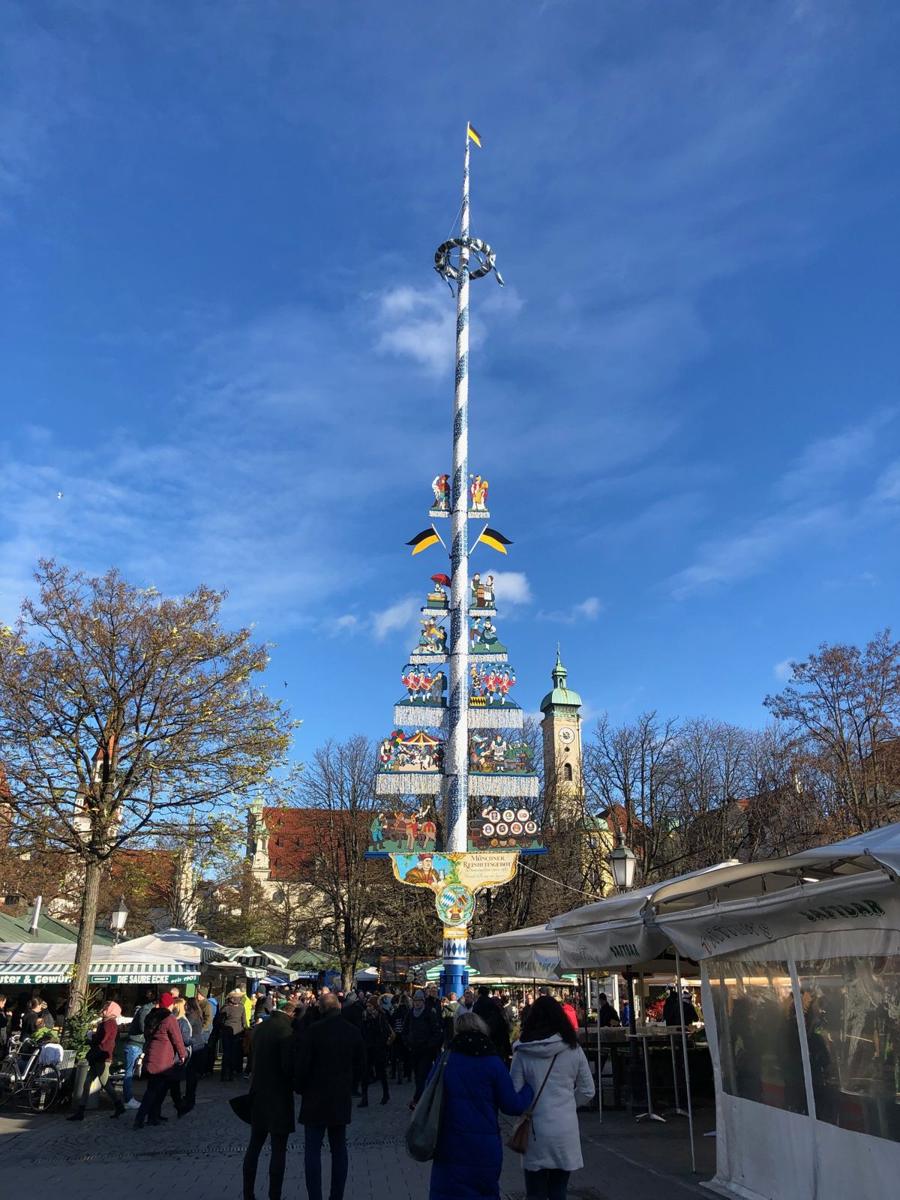
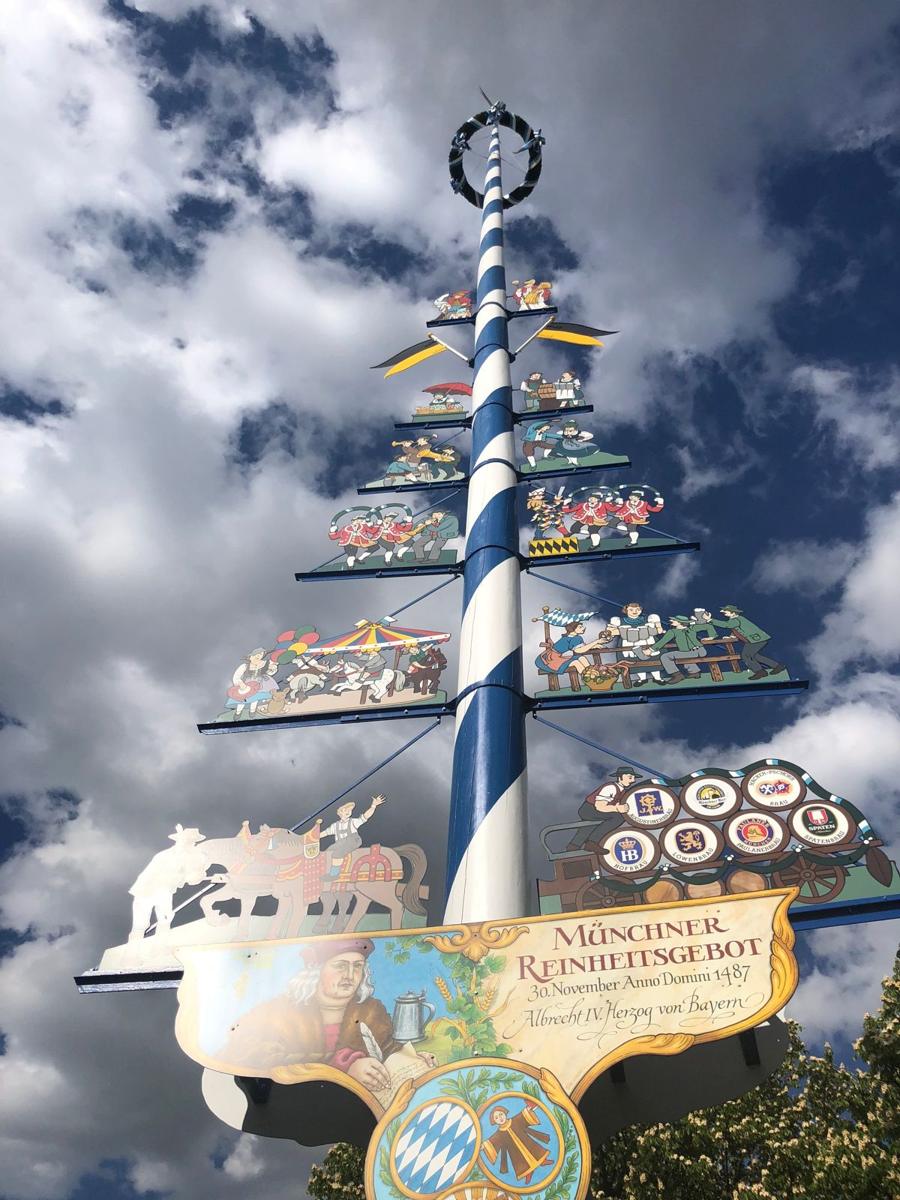
Make your way over to the blue-and-white-striped maypole. Throughout Bavaria, you'll see colorful maypoles decorating town squares, most of them painted blue and white, the colors of Bavaria. The figures along the pole show the trades and merchants who do business in the market. Look for the brewers and the dancing barrel makers, too.
During the salt-trade boom of the 1400s, Munich gained a reputation for brewing some of the best beer around. There were dozens of breweries, many of them run by monks, and the beer casks were stored in cellars right here, kept cool by shady chestnut trees. This is a good time to tell you about the Reinheitsgebot, the German Beer Purity Law of 1516. It originated here in Bavaria, and it's one of the world's oldest food laws. But Munich actually beat the rest of Bavaria to it! Look at the sign at the bottom of the maypole. It honors Munich's own Purity Law, decreed by Duke Albrecht IV on November 30, 1487, almost 30 years earlier. Beer could only have three ingredients: barley, hops, and water. No additives! Later, folks realized there was actually a fourth ingredient, yeast, which is always present in fermentation. Back in the Middle Ages, much of the water wasn't fit for drinking, so beer became liquid food.
Now take a look around and notice all the picnic tables filled with locals and tourists. This is a popular place for lunch or a snack of Weisswurst (white sausage) served with sweet mustard and a pretzel and, of course, a beer. The city keeps the fast-food chains out to keep the market as authentic as possible.
Heading farther south, you'll pass the Pschorr beer hall, and just past that, you'll come to a glass-and-iron building known as the Schrannenhalle. Back in the 1800s, this was the city's grain exchange. Today it's home to Eataly, an amazing Italian food market. If you're looking for a change from heavy German food, a stroll through here might make you want to hop a train and head across the Alps to Italy!
Exit the front doors of the Schrannenhalle, cross the busy street, and follow the signs to the Film Museum on St.-Jakobs-Platz. Just as you get to the museum, look to the left and find a modern, rectangular stone-and-glass building. This is the Ohel Jakob Synagogue, built in 2006 as the heart of Munich's Jewish quarter. The city's old main synagogue stood a few blocks away until 1938, when Hitler ordered it destroyed. In the early 1930s, about 10,000 Jews lived in Munich. By the end of World War II, very few were left. After the war, Germany welcomed Jewish refugees from the former Soviet states, and today Munich's Jewish community has rebounded to roughly 10,000 people.
The interior is closed except for worship and pre-booked tours, but take a good look at the outside. The lower stones resemble the Western Wall in Jerusalem, and the glass upper section represents the tent that held the sacred religious items during the Israelites' 40 years of wandering in the desert with Moses. The big entrance door features the first ten letters of the Hebrew alphabet, symbolizing the Ten Commandments.
It's a bit of a trek to the Asam Church. Walk past the fountain in the synagogue square, cross the street, and continue straight ahead one block on Dultstrasse until you reach Sendlinger Strasse. Turn left and walk about two blocks.
Before we go in, a little background. In the 1500s, Germany was divided by the Protestant Reformation. The north joined Martin Luther in protesting the way the Catholic Church had turned into a massive bureaucracy with lots of corruption. But those in the south, especially Bavaria, stuck solidly with the Pope and the ancient traditions of the Church. Over the next two centuries, Bavaria's churches began taking on the Italian styles we call Baroque and Rococo. Church architects expanded their palette and turned their buildings into over-the-top multimedia experiences.
Cosmas Damian and Egid Quirin Asam were two brothers who lived in Munich in the early 1700s. They were very artistic and eventually became the go-to guys when church communities were looking for creative ideas for their new buildings. They built this little church in the 1730s and 40s, squeezed into an empty space between two buildings. It's just 30 feet wide! The brothers lived right next door. Think of the church as a showroom, where prospective buyers could walk in and pick out the elements they'd like built into their own churches.
The tiny exterior looks something like a sandcastle, with a fancy doorway and rough-cut rocks at its foundation. Then step inside. It's dripping with Rococo decoration: gold, angels, swirling sculpture, and light pouring in from hidden windows above the altar. But here's the fun part. Much of that "marble" is cleverly painted, an inexpensive way to dress up the building, and the ceiling fresco tricks your eye into seeing space that isn't really there. Finally, on your way out, take a look at the Grim Reaper near the door, cutting the thread of life. A cheerful send-off!
Walk back up Sendlinger Strasse toward Marienplatz. After a few blocks, the street becomes Rosenstrasse, a pleasant pedestrian street.
As you walk, here's a bit more history. The 17th century was not so great for Munich. The ongoing conflict between Protestants and Catholics, plus several plagues, left the city broke and powerless, overshadowed by the mighty Habsburgs in Austria. Then, in the 1800s, a couple of Wittelsbach kings stepped up to the plate and transformed Munich into a modern European capital. Their style was neoclassical, the same as our own Washington, D.C., with its columns, pediments, and symmetry. Unfortunately, much of that elegance was destroyed in World War II, and Munich was rebuilt in the 1950s and 60s, with help from American Marshall Plan dollars. Dig a little and you'll still find hints of its medieval, Baroque, and neoclassical past.
Thanks to the 1972 Olympic Games, Munich got a much-needed facelift. Many baby-boomer Americans remember those Games for the tragic hostage-taking and murder of Israeli athletes by Palestinian terrorists. But for the city itself, it was a rebirth. The subway system was expanded, and cars were banned from the heart of the old town. The grand old streets connecting Marienplatz with Karlstor and Isartor became pedestrian-friendly, and Munich's historic center came back to life!
Back at Marienplatz, face the New Town Hall and head up the street to your left, Kaufingerstrasse. Since the 1100s, this has been Munich's main commercial street. Traders from along the Salt Road entered town through the fortified Karlstor gate, straight ahead about half a mile. Today, it's Munich's main shopping street, lined with department stores, local eateries, and even a famous beer hall or two. Ludwig Beck, right at Marienplatz, has been around since 1861, and the locals will tell you it's top-notch (and the most expensive).
Up until 1970, this street was chock-a-block with traffic. To clean up for the Olympics, it was turned into one of Europe's first pedestrian zones. Ha! It was a pedestrian zone a thousand years before! The shopkeepers were terrified their businesses would be ruined without cars. But as you can see, the city center is thriving. It's estimated that up to 10,000 shoppers pass through here each hour.
Walk up Kaufingerstrasse about 200 yards. On your right, you'll pass bronze statues of a wild boar and a giant catfish. Notice that parts of their anatomy have been rubbed to a golden shine by so many passersby. This is the German Hunting and Fishing Museum. Continue another 50 yards and you'll find St. Michael's Church on the right. Oh, and just across the walkway is the famous Augustiner beer hall, one of my favorites.
Let's take a look at the façade of St. Michael's. It's one of the first great Renaissance churches built north of the Alps. The design was inspired by the Gesù church in Rome, home of the Jesuits, a scholarly order that served as the intellectual defenders of the Catholic Church. St. Michael's was built in the late 1500s, right at the height of the Reformation, as the Jesuits' headquarters north of the Alps. Look up at the bronze statue of St. Michael fighting a demon. The demon? That's heresy, and the Protestant Reformation.
Inside, it's loaded with Baroque ornamentation. Notice the huge barrel-vaulted ceiling and the ornate pulpit. Up toward the altar, stairs lead down to the crypt (Fürstengruft). It costs a few euros to go down and see the tombs of the Wittelsbachs, the family who ruled Munich and Bavaria from 1180 to 1918. Find the tombs of William V, who built this church, and Maximilian I, who led Bavaria during the Thirty Years' War. Then notice King Otto, who was declared insane and deposed in 1913. King Ludwig II's tomb is the most ornate. He's well known for his Cinderella-esque castle, Neuschwanstein. He didn't spend much time here in Munich, preferring the countryside and the romanticism of the era, and his excesses earned him the nickname "Mad" King Ludwig. You'll notice flowers around his tomb. They're placed here not by the church, but by modern-day romantics. Before you leave, look for the black-and-white photos near the door showing the church after the bombings.
The Frauenkirche is the huge brick church with the two copper-green domes towering above the skyline. Exit St. Michael's, go to the left, turn left at the wild boar statue, and there it is: the Church of Our Lady.
This huge church was built in only about twenty years, beginning in 1468. Its green twin onion domes, added in 1525, are the symbol of the city. They're a bit unusual, since most Gothic-era churches have square towers or pointed steeples. Some say crusaders, inspired by the Dome of the Rock in Jerusalem, brought the idea home. In fact, cross the Alps into northern Italy and you'll notice this Eastern influence on many churches, most notably St. Mark's Basilica in Venice.
The cathedral's towers have been under renovation for years, so don't be surprised by scaffolding. If the front door is closed, take a lap around the outside to find the entrance. As you go, notice the naked brick, with no stucco or stone façade. These bricks were made locally and, as you can imagine, they were cheap. Notice, too, the tombstones mounted on the outside walls, just like we found at St. Peter's.
Now, as you step inside, look down at the floor by the entrance and find a black footprint. Here's the story. The builder made a deal with the devil, who agreed to help build the church, but only if it had no windows. When it was finished, the builder led the devil to this very spot. Standing here, the columns block every window from view, so the devil saw nothing but a dark, windowless church. He stomped his foot in glee, leaving his mark. Then he took a few steps farther in, saw the light streaming through all those windows, and realized he'd been tricked! Some say he flew off in such a rage that he's the reason for the wind that whips around the church to this day.
As you head in, look for the black-and-white photos of the church after the bombing raids of 1944. The towers survived, but the rest of the building was devastated and had to be rebuilt. The big black ornate tomb at the rear honors Ludwig the Bavarian. Ludwig was born in Munich and became ruler of Bavaria in the 1300s, then Holy Roman Emperor. As a result, Munich became a noted European city. Ludwig also granted Munich a monopoly on the salt trade, which helped make it a major power.
Look at the last pew on the left. The plaque honors Joseph Ratzinger, who was born in Bavaria in 1927. He was the Archbishop of this church from 1977 until 1982, then moved to the Vatican to be part of Pope John Paul II's team. In 2005, he became Pope Benedict XVI.
Walking up the main aisle, notice the modern stained-glass windows, which were installed after the war. Then walk around behind the altar to the apse. The three tall windows here still have their 15th-century stained glass. The only reason they survived the bombs is that each pane was carefully removed and packed away before the raids.
Just around the corner from the Frauenkirche, on Promenadeplatz, is the Bayerischer Hof, a fancy hotel where many celebrities stay when visiting Munich. One of them was Michael Jackson, and fans would gather in the little park across the street, hoping to catch a glimpse of him. When he died in 2009, fans turned the nearby statue of Renaissance composer Orlando di Lasso into a makeshift memorial, covering it with flowers, photos, and mementos. Believe it or not, they're still doing it!
Now make your way back to the New Town Hall. The big open square just behind it is the Marienhof. There were once buildings here, but after the bombings of 1945, it was decided to leave it open as a green space. These days, mind you, it's a huge construction site for a new S-Bahn line. Walk along the east side of the Marienhof to Dallmayr Delicatessen on Dienerstrasse. Head inside and notice the old sign with the royal seal by the door: Königlich Bayerischer Hof-Lieferant, "Royal Bavarian Purveyor to the Court." Just as the Hofbräuhaus was the king's brewery, Dallmayr was the king's deli. It's a great place to pick up meats, cheeses, fine wine, and fresh seafood. But today, it's most famous for its chocolates, sweets, and coffee.
Walking toward the Hofbräuhaus, you're walking through old medieval Munich. This area was destroyed by the bombs of World War II. When faced with reconstruction, German cities had a choice: build new, or rebuild in the old style. The little square here, known as the Platzl, is a great example of the second choice. First, the bricks and rubble were hauled away. Then the walls went back up, and new roofs went on to keep the structures dry. Over the next few decades, the exteriors were refurbished and, finally, the interiors were rebuilt. It took more than half a century! Today, the Platzl looks much as it did in the Middle Ages. And notice how new mixes with old, with places like the Hard Rock Café right alongside old-world restaurants.
And there it is. I suppose the Hofbräuhaus is the world's most famous beer hall. Duke Wilhelm V founded the brewery in 1589, and as the crown logo suggests, it was the Wittelsbachs' personal brewery, making the Hofbräu, or "royal brew." In the 1890s, the brewing moved out of town, and this building became the beer hall you see today, seating thousands. It was badly damaged in World War II and was one of the first places to be rebuilt. Priorities!
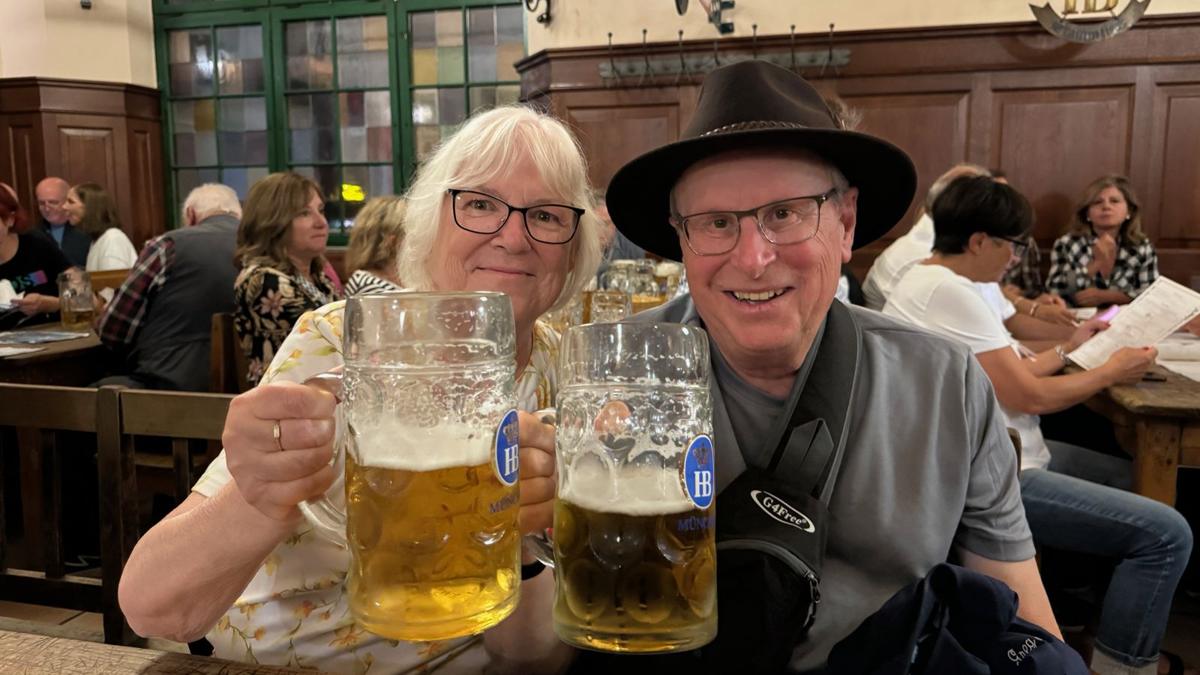
Heading inside, you'll smell the hops and feel the heat. It's loaded with people, most of them loaded as well. You'll hear an oom-pah band, see people in lederhosen and dirndls, and notice the dull roar of thousands of people talking. Even if you don't like beer, you gotta have one here. Find an empty seat on a bench, and don't worry if there are already people at the table. Everyone in Germany shares. Order some food and a liter of Hofbräu. Prost!
From the Hofbräuhaus, walk north a couple of blocks to Maximilianstrasse, Munich's grandest shopping boulevard, lined with designer boutiques. Turn left and you'll arrive at Max-Joseph-Platz, home to the city's royal palace, its opera house, and the beginning of one of the most sobering walks in Europe.
The statue in the center is Maximilian I Joseph, Bavaria's first king. When Napoleon swept through in 1805, Max Joseph was a duke. Napoleon wanted ties to an old royal family, so he arranged for Max Joseph's daughter to marry his stepson, and on January 1, 1806, Max Joseph became a king. The columned building is the National Theater, home of the Bavarian State Opera. Several of Richard Wagner's operas premiered here. Look up at the Roman numerals MCMLXIII: that's 1963, the year it reopened after being rebuilt from the war.
The enormous building facing the theater is the Residenz, the city palace of the Wittelsbachs for some four centuries. It started as a simple medieval castle, and each generation tacked on wings, courtyards, and ever-fancier rooms. Mind you, it's huge: more than 130 rooms are open to visitors. Highlights include the Antiquarium, a long Renaissance hall lined with Roman busts; the Treasury, with royal crowns and jewels; and the Cuvilliés Theater, a gilded little Rococo jewel box where Mozart premiered his opera Idomeneo. Buy separate tickets for each or a combination ticket at the entrance, and allow two to three hours. In summer, the court moved out to Nymphenburg Palace (see "Beyond the Old Town").
Now walk up Residenzstrasse toward Odeonsplatz. It was here, on November 9, 1923, that Hitler tried to seize power. The night before, he had stormed a political rally in a beer hall across the river. The next day, he and about 2,000 followers marched through town toward the government buildings. At the Feldherrnhalle, the big open loggia at the end of this street, the state police were waiting. Shots rang out, and four policemen and more than a dozen Nazis were killed. The coup collapsed, and Hitler was sent to prison in Landsberg, west of Munich. He served only about nine months, and he used the time to write Mein Kampf.
Ten years later, Hitler was in power, and he turned the Feldherrnhalle into a shrine to his "martyrs," with an honor guard. Anyone walking past was expected to give the Nazi salute. So how did ordinary Münchners avoid it? They ducked down the little lane on the left, Viscardigasse, to slip around the square. Look down: a winding trail of bronze cobblestones traces the path of those quiet acts of defiance. Locals nicknamed it Drückebergergasse, the "Dodgers' Alley."
The Feldherrnhalle itself was built in the 1840s by King Ludwig I as a hall to honor Bavaria's generals, and it's a copy of the Loggia dei Lanzi in Florence. Across the street, the mustard-yellow church with twin towers and a big dome is the Theatinerkirche, a High Baroque church built in the Italian style. Its crypt holds many more Wittelsbach tombs. Behind the loggia, the Hofgarten, the old royal garden, is a peaceful spot to rest your feet.
Look up Ludwigstrasse, the grand boulevard heading north. Less than a mile away is the Victory Gate (Siegestor), topped by a goddess riding a lion-drawn chariot. To the west, down Brienner Strasse, you can make out a tall black obelisk. It honors the 30,000 Bavarian soldiers who marched with Napoleon to Russia in 1812 and never came home. Just beyond is Königsplatz, the neoclassical square the Nazis used for their mass rallies. The party's headquarters stood nearby. Today, on that very site, the NS-Documentation Center tells the story of Munich's role in the rise of National Socialism. Admission is free, and it's well worth an hour.
One more connection worth knowing: in February 1920, in the Festsaal upstairs at the Hofbräuhaus, Hitler presented the Nazi party's program for the first time. The beer-hall culture that makes Munich so welcoming was also where the movement began.
Oktoberfest crowds can wear you down. When you need a break from the tents, these are my favorite escapes, all easy to reach by U-Bahn, S-Bahn, or tram.
Stretching north from the Hofgarten, this is one of the largest city parks in the world, bigger than New York's Central Park. Start at its southern tip, where the Eisbach stream rushes out from under a bridge on Prinzregentenstrasse and forms a standing wave. Surfers line up on the bank, take turns riding the wave, and draw a crowd of onlookers all day long. Deeper into the park, the Chinese Tower beer garden seats thousands under the chestnut trees. A word of warning from personal experience: the first time I rented a bike and pedaled through the park, I came around a bend and nearly crashed into a tree. A father and son were playing Frisbee on the meadow — both of them completely naked! Many Münchners are not bothered by nudity, and certain meadows are clothing-optional. Consider yourself warned, or blessed… the choice is yours!
Take the U3 to Olympiazentrum to see the grounds of the 1972 Summer Olympics. The stadium and arenas are covered with sweeping, tent-like roofs of acrylic glass panels held up by cables — radical design in its day, and still striking. Walk into the swimming hall for a close look at that web-like roof, or ride the elevator up the Olympic Tower for a sweeping view of the city and the Alps. A memorial near the athletes' village honors the eleven Israeli team members and the West German police officer killed in the 1972 attack. Car fans can cross the street to BMW Welt, the automaker's flashy showroom.
This was the Wittelsbachs' summer palace, a few miles west of the center (tram 17 from the Hauptbahnhof). The grand Baroque wings stretch along a canal lined with swans, and King Ludwig II was born here in 1845. Inside, don't miss the Gallery of Beauties, King Ludwig I's collection of portraits of the most beautiful women of his day. Out back, the Marstall Museum displays the royal family's golden coaches and sleighs, including Ludwig II's over-the-top fairy-tale carriages. Allow half a day with the gardens.
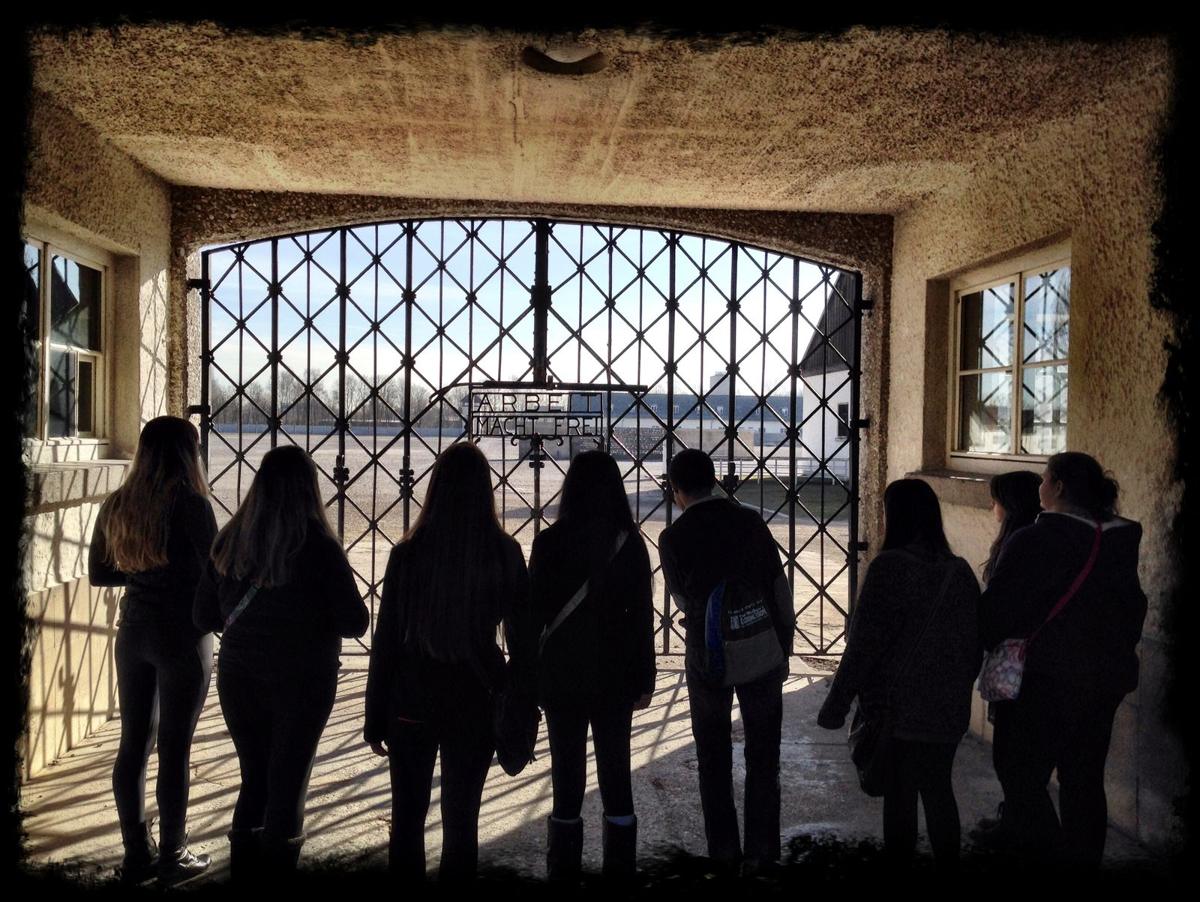
Opened in March 1933, just weeks after Hitler came to power, Dachau was the Nazis' first concentration camp, and it became the model for all that followed. More than 200,000 people from across Europe were imprisoned here, and tens of thousands died. The memorial site preserves the roll-call square, a reconstructed barracks, the crematorium, and a thorough museum. It's a somber visit, but an important one. Take the S2 to Dachau, then bus 726 to the memorial. Admission is free; allow three to four hours. On my Germany tours, we always stop here on the way into Munich.
Can't make it to Oktoberfest? The same Theresienwiese hosts the Frühlingsfest (Spring Festival) every April and May. I once happened upon its opening ceremony while on tour: marching bands, horse-drawn beer wagons, and dozens of antique pistols fired into the air to welcome spring. Think of it as a smaller, more local version of Oktoberfest, with lederhosen, dirndls, beer, and sausages.
Munich makes a great base. King Ludwig II's Neuschwanstein Castle is about two hours southwest, and Salzburg, Mozart's hometown, is about an hour and a half by train.
In Munich, beer isn't just a drink. For centuries, when the water wasn't safe and food was scarce, it was "liquid bread." The big six breweries — Augustiner, Hacker-Pschorr, Hofbräu, Löwenbräu, Paulaner, and Spaten — still brew under the old Purity Law. Here's what you'll see on the menu:
A Mass (pronounced "mahss") is a one-liter mug. When you toast, look your tablemates in the eye and say "Prost!" Legend has it that skipping the eye contact brings seven years of bad luck.
Beyond the Hofbräuhaus, try the Augustiner Stammhaus on Neuhauser Strasse, a favorite of the locals, or the Löwenbräukeller near Stiglmaierplatz. When the weather's good, head to a beer garden. Here's something you'll love: in a traditional Bavarian beer garden, you're allowed to bring your own picnic. Buy your drinks there, but pack sausages, cheese, and bread from the Viktualienmarkt, and spread out under the chestnut trees. The Viktualienmarkt and the Chinese Tower in the English Garden are two of the best.
You'll see them hanging at every Wiesn stall: big gingerbread hearts decorated with icing messages like I mog di ("I like you" in Bavarian dialect). Couples buy them for each other, and they make the perfect souvenir. Just don't plan on eating it. They're made to hang on the wall, not to be eaten.
Munich has a big Italian streak, thanks to its Catholic ties and its location just north of the Alps. Two of my favorites are Trattoria da Fausto, where my friend Fausto serves some of the best Italian food in the city, and Ristorante Italy. Both are in the Schwabing neighborhood. My tour groups always rave about these two places.
Would you rather let someone else handle the hotels, the trains, and the tent strategy? Two of my 2027 tours are timed to end in Munich while the Wiesn is in full swing.
| Tour | 2027 dates | Price from | Oktoberfest |
|---|---|---|---|
| Germany, Austria & Switzerland in 12 Days | Sept 13–24, 2027 | $4,849 + air | Final days in Munich during the festival's first week |
| Germany, Austria & Switzerland, alternate route | Sept 22–30, 2027 | TBA | Munich during the festival |
The 12-day tour starts in imperial Vienna, then heads to Salzburg, Neuschwanstein Castle, the Swiss Alps in the Lauterbrunnen Valley, and medieval Rothenburg. We finish with a visit to the Dachau memorial and two days in Munich, including my old-town walking tour and time at the Wiesn. Groups are small, 18 or fewer travelers, and all tips are included. Our September 2026 departure sold out, so don't wait too long. See all dates on my Germany & Austria tours page.
Want more Munich? Read my story, I Learned to Ride the Subway in Munich, and Spring Has Arrived in Europe, about the Frühlingsfest on the Oktoberfest grounds.
See you at the Wiesn. Prost!