

Contest:
Help Us Name the Newsletter
We have a small problem… our monthly newsletter is currently called “Newsletter.” 😅 I think we can do better so lets turn it into a contest!
What should we call the David McGuffin Exploring Europe Monthly Newsletter?
Put on your creative thinking cap and come up with a name that is:
- Fun
- Catchy
- European-inspired
The winning name gets bragging rights AND the honor of naming this newsletter for all future issues!
Send us an email (david@davidmcguffin.com) with your best idea and let’s see who can come up with the winner!
Ready… set… NAME IT!
Blog Article:
Why I Love to Visit Paris
 Of all the places I’ve traveled across Europe, Paris keeps its place at the top of my list. It has the grand boulevards, the boutiques, the outdoor cafés, the monuments and museums everyone comes for — and it has the Mona Lisa, the Eiffel Tower, and Notre Dame. But none of that fully explains why it’s my favorite. What does is something quieter: the way Paris rewards you for slowing down.
It’s a City of Neighborhoods, Not Just Sights
Ask me why Paris beats out every other city I’ve visited, and my answer is that it isn’t really about the landmarks. It’s that Paris is made up of dozens of distinct neighborhoods where I can step away from the tourist crowds entirely. You should absolutely see the big attractions — but there’s so much more to the city than one more museum or one more church.
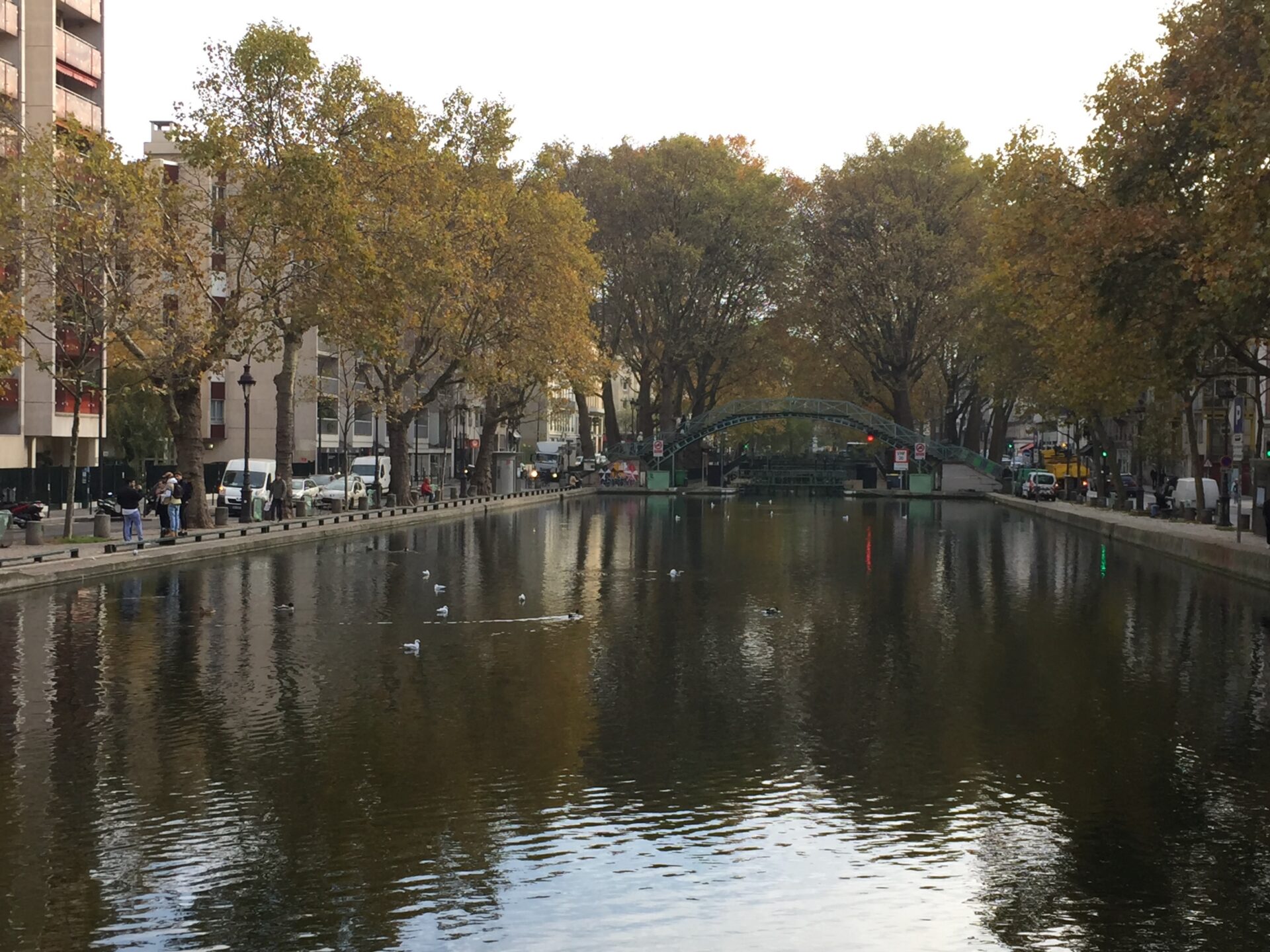 One of my favorite escapes is the Canal Saint-Martin, a canal dug in the early 1800s to move grain and building materials into the city. I once spent an entire late-September morning just walking one bank and back down the other — watching kids float leaves and toy boats, moms pushing strollers, cafés and bistros getting ready for the lunch crowd, all happening beneath the amber and gold leaves of the ubiquitous plane trees. No horns, no traffic, no tour groups. Just Paris living its ordinary life.
I feel the same way about the streets near the Eiffel Tower, Champ de Mars, and Pont de l’Alma, where 18th-century blocks between Rue Saint-Dominique and the Seine are full of actual Parisians going about their day. After reading Julia Child’s biography, I learned she once lived in a small upper-floor apartment on Rue de l’Université. I still find myself walking that street, looking up, wondering who lives there in her old apartment now.
Slow Down — You’ll Enjoy It More
Paris can wear you out. I’ve led groups through two packed days trying to hit the Eiffel Tower, the Louvre, Notre Dame, the Tuileries, Luxembourg Gardens, a Seine cruise, Montmartre and Sacré-Cœur, the Champs-Élysées, and a picnic on the Champ de Mars — and by day two, travelers from age 13 to 80 are all asking for the same thing: more time to breathe, to slow down, to get a break.
That’s why in the past decade I’ve moved toward longer stays and fewer forced stops per day. The sights will still be there. What people remember afterward isn’t how many boxes they checked — it’s the afternoon they didn’t rush, sitting at an outdoor café with a drink, or enjoying a quiet corner in a park on a shaded bench.
A City Built for Eating Well
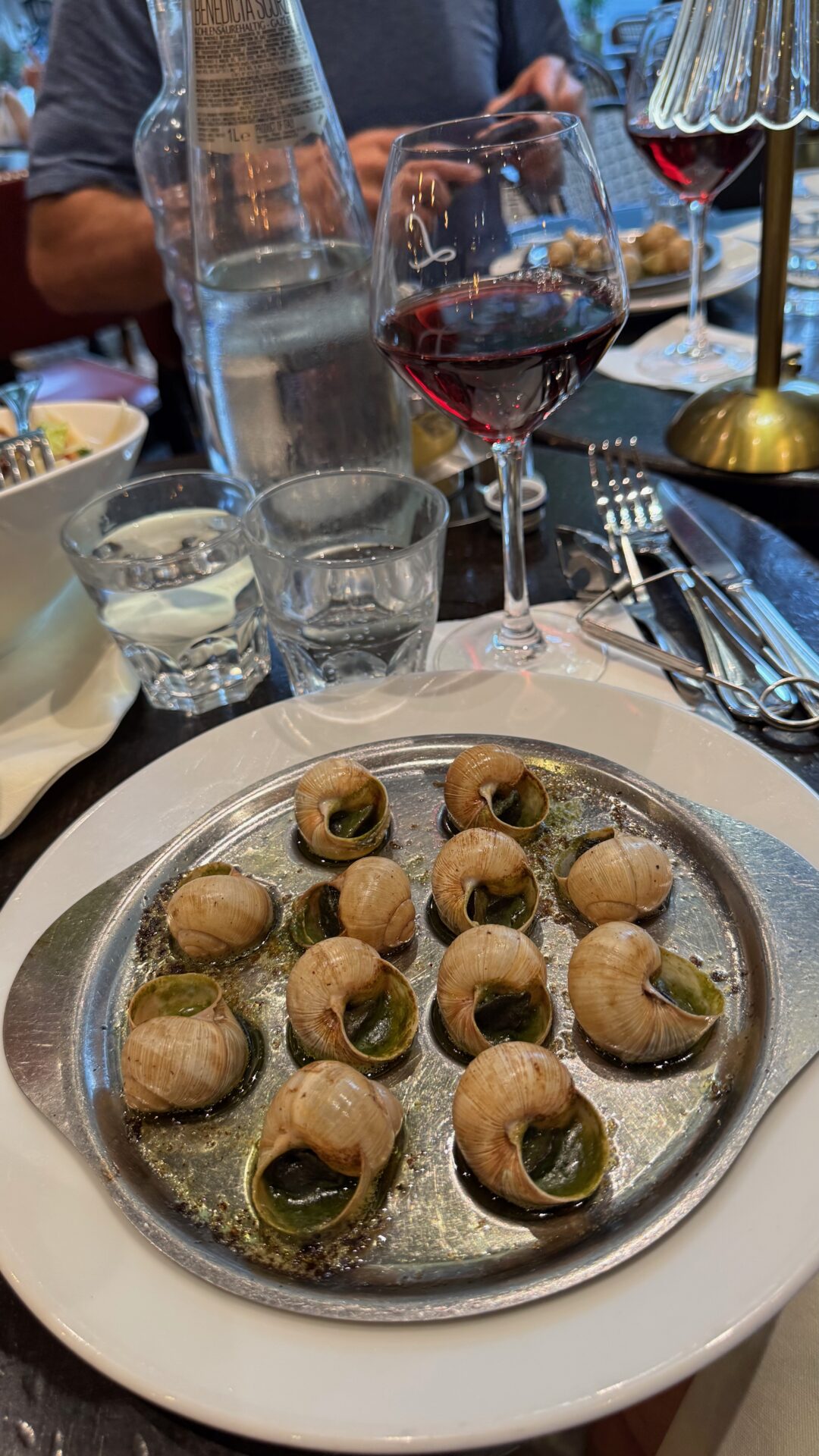 Paris might be the best city in the world for a meal, whatever form that takes — a picnic along the Seine, a coffee and croissant to start the day, or a proper multi-course dinner. My rule of thumb: skip anywhere with a big multilingual menu posted outside. That’s a sign the kitchen isn’t cooking for repeat customers — it’s cooking for someone who’ll only ever eat there once.
Instead, look for where the locals eat. Avoid the tourist traps in the Latin Quarter, around the Louvre, Champs-Élysées, or up on Montmartre. Instead, find a secluded neighborhood and a small restaurant. Look for handwritten menus of the day, often sitting out front on a black chalkboard. I love starting with escargot and a good baguette, then moving to confit de canard — duck leg and thigh cooked slow in its own fat until it’s falling off the bone. Near Notre Dame, several small places tucked into a sandy little triangle of a square called Place Dauphine serve a seasonal formule menu — try the bœuf bourguignon or onion soup (but only if you’re there in winter or fall).
A few practical notes that catch people off guard: drinks don’t come with refills or much ice, though tap water is free if you ask for une carafe d’eau. Meals are a social event, not a race — your waiter won’t rush you, and you shouldn’t rush yourself either. And a service charge is already built into your bill, so tipping is a nice gesture, not an obligation.
Even the Hard Days Are Worth It
I was in Paris in April 2019, just days after the fire at Notre Dame. The mood on the streets was nothing like the Paris I knew — shock and quiet disbelief where there’s usually so much energy. Rounding a corner onto Rue Saint-Jacques and seeing the burnt-out cathedral for the first time stopped me in my tracks, and I wasn’t the only one. Even now, with most of the restoration complete, that image is part of the city’s story — a reminder that Paris isn’t just postcards, it’s a living place that endures.
So, Go — But Go Slowly
Climb the Eiffel Tower. Walk the Champs-Élysées. Stand in front of the Mona Lisa if you must. But don’t let the checklist run the trip. Find a bench in a park, a table at a sidewalk café, a canal to walk beside. Paris rewards the traveler who’s willing to slow down and just be in it.
That’s why, after all these years and all these cities, Paris is still my favorite. Next month, I’ll tell you my secret to landing a table with a view at the Eiffel Tower… for a reasonable price. Until then, au revoir.
Tour Highlight:
Cruising Croatia
ONLY 4 SPOTS REMAINING!
This trip is set for July 24-31, 2027. Prices start at $3,489 plus airfare.

David’s Travel Tip:
Moneybelt – Never Leave Home Without It
 After decades of leading tours across Europe, there’s one habit I recommend to every traveler, every single time: wear a moneybelt. It’s not glamorous, it’s not exciting, and it’s not fashionable. But it’s one of the simplest ways to protect yourself — and your trip — from disaster.
It Starts Before You Even Leave Home
I still remember packing for one of my very first tours back in 1997. Amid the rush of last-minute errands, the bank run for traveler’s checks, and the scramble to get everyone out the door, one step always stood out: the “passport and moneybelt check.” Before we ever climbed into the car for the airport, we made sure everyone had their valuables secured. That habit has stuck with me for nearly three decades, and it’s saved me — and the travelers on my tours — more headaches than I can count.
What Actually Goes in a Moneybelt
A moneybelt isn’t for everything in your wallet. It’s for the things you truly cannot afford to lose: your passport, credit cards, medical information, and the cash you are carrying around. I keep my passport tucked inside a small plastic sandwich bag before it goes in the belt, just to keep it dry and protected. If your passport is ever lost while you’re out of the country, you’ll be looking at days of delays and a mandatory trip to a U.S. embassy to get a replacement. That’s not how anyone wants to spend their vacation.

As for cash, I don’t recommend carrying hundreds of dollars around, whether it’s in your wallet or your moneybelt. I do keep a small amount of U.S. dollars tucked away, mostly out of habit and for a bit of comfort — it’s nice to have something familiar when you land back home. But the bulk of your spending money should be in the local currency, exchanged at an airport or a reputable location, or ATM machine once you arrive, not carried in bulk from the start.
Wear It, Don’t Just Pack It
The key word is “wear.” A moneybelt does you no good sitting in the bottom of a suitcase. It needs to be under your clothes, against your body, out of sight. I keep mine on throughout the day when I’m out exploring, and I transfer what I need once I’m settled “in country” and in my hotel room. The goal is simple: your most essential items should never be in a bag that can be snatched, unzipped, or set down and forgotten.
Don’t Let Your Guard Down
I’ve said it before and I’ll keep saying it: don’t trust everyone you meet on the road. Most people you’ll encounter while traveling are kind and helpful, but it only takes one bad moment — a distraction, a crowded platform, a friendly stranger with the wrong intentions — to lose something important. That’s the whole point of a moneybelt. It’s not about assuming the worst of people; it’s about making sure that if something does go wrong, it doesn’t wreck your trip.
 The Bottom Line
 The Bottom Line
A moneybelt is one of the least expensive, least complicated things you’ll pack for a trip abroad — and it might be the most important. It keeps your passport, cards, and cash close, secure, and out of reach of pickpockets and thieves who specifically target tourists. Make it part of your routine before you even leave the house, and keep it on throughout your travels. It’s a small habit that provides real peace of mind, and after all these years of touring Europe, it’s one I’ll never travel without.

Discounted Tours:
Best of London & Paris
Best of London, Paris, & Rome
Before I let you go this month, a quick heads-up if fall travel is anywhere on your radar: three of our tours are currently discounted, and the first two are close enough now that seats won’t last.
The Best of London and Paris tour provides an opportunity to settle in and experience two of Europe’s major capital cities. Enjoy four nights in each city with freetime to do some exploring on your own.
The Best of London, Paris, and Rome tour provides an opportunity to settle in and experience three of Europe’s major capital cities. Enjoy four nights in each city with freetime to do some exploring on your own.
Deals, offers, and information included in this newsletter are time-sensitive and may no longer be active or accurate by the time you’re reading this. While we strive for accuracy, errors or omissions may occur, and we recommend verifying details directly with the source before making any decisions. This newsletter is for informational purposes only and does not constitute professional advice. All opinions expressed are our own.