Mount Etna and the Gambino Family winery

Mount Etna and the Gambino Family winery

by David McGuffin

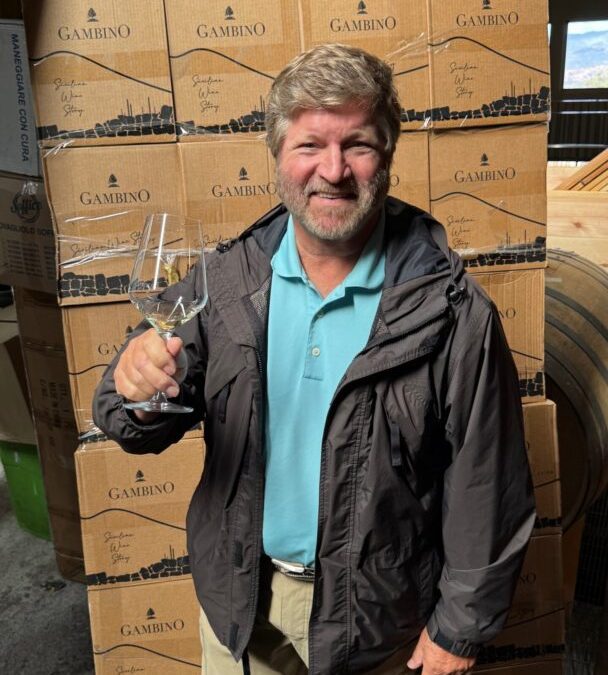
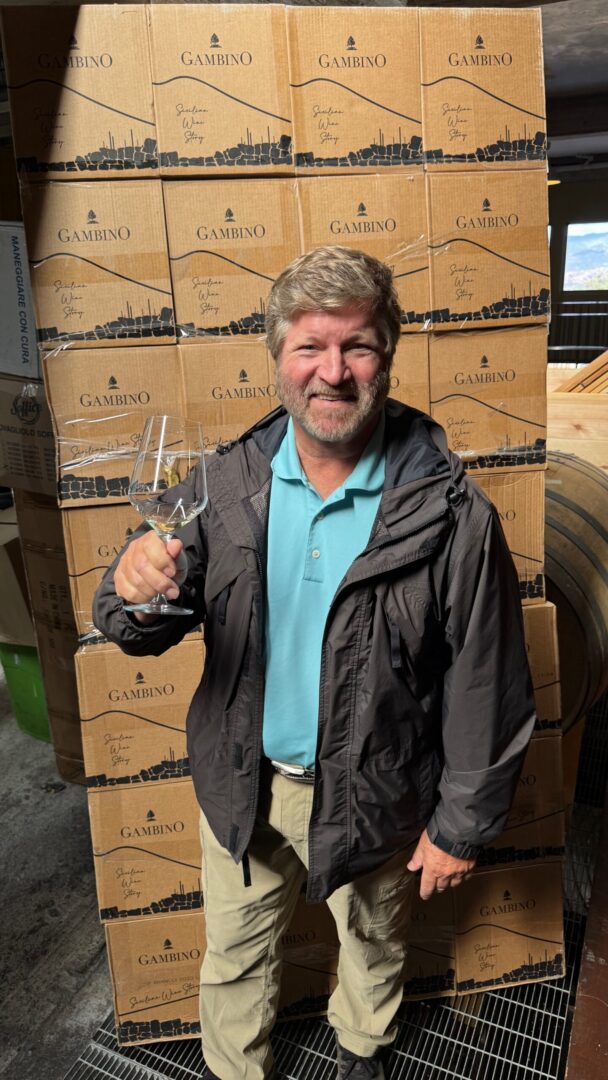
I was up on Mount Etna with my Sicilian friend, Paolo, a few months ago. After winding through the lava fields and trekking down into a crater, we had had all the cold and desolate volcanic slopes we could stand for the day. So we headed back down the northern slope of Etna to the Gambino family winery.

The Gambino estate sits at about 2,600 feet above sea level on the eastern slope of Mount Etna, perched right there in the National Park with views stretching across the Taormina coastline and the Mediterranean. Getting there means winding your way up mountain roads through volcanic landscape, and I won’t lie to you—the drive can be a bit nerve-wracking if you’re not used to mountain driving. But the moment you arrive and see those terraced vineyards spreading out with the sea glittering in the distance, you understand why this place is special.

Here’s what makes Gambino extraordinary. This is a family operation that’s been at it for over twenty years, with the Raciti Gambino siblings—Francesco, Filadelfo, and Mariagrazia—pouring their hearts into every aspect of the winery. Francesco grew up watching his parents buy land piece by piece on Etna, and his mother Maria came from a long line of Etna vintners. You can taste it in the wines, and you can feel it in how the family welcomes visitors. When Filadelfo takes you down into their cellar—carved ten meters deep into volcanic rock—and explains their winemaking philosophy, you’re not getting a corporate tour. You’re getting invited into their passion.

The volcanic terroir here is remarkable. The soil is rich with minerals from Etna’s eruptions, and those high-altitude vineyards get that dramatic temperature swing between day and night that’s crucial for developing complex flavors in the grapes. They’re working with indigenous varieties—Nerello Mascalese and Nerello Cappuccio for the reds, Carricante and Catarratto for the whites. The Tifeo Etna Rosso has this beautiful pale ruby color with aromas that just keep unfolding—cherry, leather, coffee, vanilla. And the Tifeo Etna Bianco? It’s got this bright citrus character with touches of pepper. I could taste the soil and the sea breeze in it.

We booked their full experience—the wine tasting paired with food. They serve you five wines alongside a three-course meal of traditional Sicilian specialties, and their sommeliers know how to guide you through the pairings without being pretentious about it. The antipasti plate and the lentil and chickpea soup were perfect pairings with the wine. And that view from their terrace? Breathtaking doesn’t quite cover it. You’re looking out over terraced vineyards with the Mediterranean spread out before you, and you’re tasting wines that couldn’t come from anywhere else on earth.

The Gambino siblings practice sustainable viticulture—hand-picking their grapes, using natural pest control, doing things the way their parents and grandparents would recognize. But they’re not stuck in the past. They’ve married traditional methods with modern techniques to create wines that speak authentically to this place while meeting international quality standards. You can find their wines in restaurants, but experiencing them here, where they’re made, is something entirely different.

What I love about bringing people to Gambino is that authenticity. There’s no pretense here, no over-the-top wine snobbery. Just a family that loves what they do, making exceptional wines in one of the most dramatic settings you’ll find anywhere. They welcome you like you’re visiting their home—because you are. After your tasting and tour, you can browse their shop, stock up on bottles (they ship worldwide), and maybe grab some of their olive oil, which comes from trees growing at the same altitude as the vines.

The winery gets busy, especially in summer, so I suggest booking ahead. And yes, it takes effort to get there. But that effort is part of what makes it memorable. This isn’t a quick stop on a tour bus circuit. It’s a genuine experience with people who have deep roots in this volcanic soil, who’ve been dealing with Etna’s challenges and gifts for generations, and who make wines that taste like nowhere else on earth.

1977 Lunch in Rome on flight layover to Athens

David and Paolo

1977 Lunch in Rome on flight layover to Athens
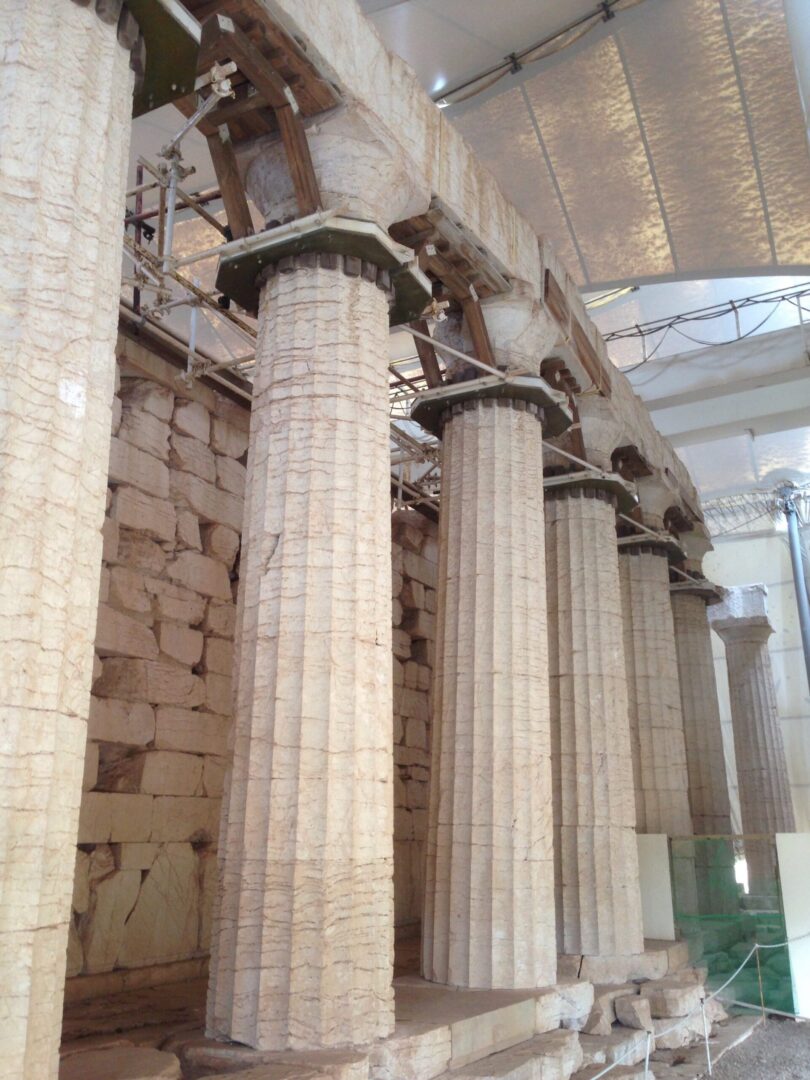
Temple of Apollo Epicurius at Bassae

Temple of Apollo Epicurius at Bassae

by David McGuffin

I’ve been leading tours to Greece for years now, and I’ve found most travelers pack their itineraries with Athens and the islands—and don’t get me wrong, those are must-sees. But if you want to experience something truly special, something that’ll stick with you long after you’ve unpacked your suitcase back home, you need to make the trek to Bassae.


The Temple of Apollo Epicurius sits high up in the Peloponnese mountains at about 3,700 feet, perched on a remote mountainside that feels like the edge of the world. Getting there isn’t exactly a hop, skip, and jump—you’re looking at about an hour’s drive from the nearest town through winding mountain roads. But trust me, that journey is part of what makes this place so remarkable. When you finally arrive and see this ancient temple standing against the rugged Arcadian landscape, it hits you. This is what the ancient Greeks were all about—reaching for the divine in the most awe-inspiring places they could find.


Here’s what makes Bassae extraordinary. First, it’s one of the best-preserved Greek temples you’ll see anywhere, right up there with the Hephaisteion in Athens. The locals built it back in the 5th century BC, probably designed by Ictinus—yes, the same architect who worked on the Parthenon. They dedicated it to Apollo Epicurius, which means Apollo the Helper, supposedly after he protected them from a plague. And get this: unlike most Greek temples that face east-west, this one runs north-south. Some say it’s because of the steep terrain, others think it is aligned with an older temple on the site. Either way, it’s different, and different is good when you’re exploring ancient Greece.


Now, I won’t sugarcoat it—the temple is currently covered with a protective tent structure. It’s not the most photogenic thing you’ve ever seen (from afar). They shrouded the temple to prevent further weathering and decay, but the tent detracts from that “ancient ruins in the mountains” aesthetic we all love. The beautiful sculptural frieze that once decorated the interior—showing battles between Greeks and Amazons, and Lapiths and Centaurs—was carted off to the British Museum back in the day. I’ve seen those in London, as well, but that’s a whole other conversation, and one the Greeks aren’t too happy about.


But here’s the thing. Even with the tent and without the original sculptures, standing at Bassae is an experience you can’t get at the more famous sites. The remoteness that kept this temple remarkably intact for over two millennia is the same quality that makes visiting it feel like a genuine discovery. You’re not battling crowds or tour buses. Instead, you’re surrounded by wild, windswept mountains with views stretching across untamed valleys. That isolation lets you really feel what those ancient worshippers must have felt when they climbed up here to honor Apollo.


I can only bring my friends here when I’m driving with 4-6 people.  But when we get here, they always tell me Bassae was one of the tour’s highlights. It’s authentic. It’s dramatic. And it reminds you that the best travel experiences aren’t always the ones in the guidebooks—sometimes they’re the ones that take a little extra effort to reach.
1977 Lunch in Rome on flight layover to Athens
Travel Talk Tuesday Dispatch – November 25, 2025

Travel Talk Tuesday Dispatch – November 25, 2025

1. Travel Hint – Bring a Drawstring Backpack

We send this lightweight drawstring backpack to all who sign up for a David McGuffin tour. It’s a multipurpose bag to carry small items with ease. Use it on the bus to keep your snacks, lotions, and supplies handy. Or use it as a day bag, like I do, to carry only what’s needed for the moment. But the sad thing is, more often than not, folks show up on tour and have left their DMEE bag at home. It’s only then that they realize what a mistake it is!


2. Destination Deep-Dive: Munich, Germany—The Ratskeller

The Ratskeller München is a famous historic restaurant located in the basement of the New Town Hall (Neues Rathaus), right at Marienplatz in the heart of Munich. It has a history dating back over 150 years, having opened in 1874, and is genuinely a Munich institution.

The restaurant features over 1,000 seats across 15 function rooms, with stunning neo-Gothic architecture, vaulted ceilings, and a magnificent Prunkhof (courtyard). The historic ambiance makes it worth visiting to see the interior itself.

The restaurant offers authentic Bavarian and Franconian cuisine.  The menu includes: Classic Bavarian delicacies like schnitzel, sausages, and roast pork; vegan and vegetarian options; and a variety of sides, including several potato-based options made with fresh ingredients, preferably sourced from the region.

The restaurant also includes additional spaces: a Bistro & Wine Bar, the Royal Dolores Munich Pub & Bar (which stays open until 1:00 AM), and a Franconian wine tavern.

The restaurant is open Monday to Sunday, including public holidays, from 11:00 AM to 11:00 PM. The prices are moderate, typically €20-30 per person for a meal. It’s popular, so I recommend making a reservation.

3. Behind the Scenes: Madame Brassiere – The Affordable Eiffel Tower Restaurant

I’ve visited the Eiffel Tower dozens of times, but it was only a few years ago that I discovered Madame Brassiere. Located on the first level, Madame Brassiere offers an affordable bar and restaurant with stunning views across Paris’ skyline.  

 Most tourists visit the Eiffel Tower for the ride to the top, a look around, and then hurry back down. But if you plan to linger a little, taking your time over drinks is an excellent way to experience Paris. Here’s my story.

 A few years ago, I was doing a private tour for a mom, dad, and teenage daughter. They tended to linger and shop a lot and did not really care much about art, history, or culture. When we got to the Eiffel Tower, they were loaded with shopping packages, so I volunteered to go up to the first level, find a seat, and watch their shopping bags while they ascended to the top.  

 It was mid-afternoon when I arrived on level one, so I asked if I could visit the Madame Brassiere bar to sit a while and have a drink. It was July, I was hot and sweaty, so I didn’t think I’d have much chance of getting into an upscale bar on the Eiffel Tower. But I was wrong!

 Actually, there were very few people inside. The bar looked out over the Seine and the Trocadéro, with sweeping vistas across Paris. So, for the price of an expensive glass of wine, I had the place practically to myself for the afternoon. After a bit, I asked what it would take for me to bring in my guests for dinner. Unfortunately, the dining area upstairs was fully booked, but the waiter told me I could stay in my comfy seat (with incredible views) and tell my friends to join me when they wished. That began a late-afternoon experience capped off by a vivid sunset dinner overlooking Paris! It probably cost me €100 for my drinks and dinner, but it was an experience of a lifetime, and significantly cheaper than booking a table at the upstairs restaurant.

ZOOM Webinar TONIGHT – Exploring Beyond Europe

Join me tonight on this live Zoom Webinar. In less than an hour, you’ll learn all about our tours and experiences in THE SERENGETI and ECUADOR.  Register here.

7:30 P.M. EST

Please note the travel details, promotions, and offers mentioned in this TTT Dispatch are timed and dated and subject to change.

Exploring Beyond Europe: New Destinations, New Adventures!

Exploring Beyond Europe: New Destinations, New Adventures!

For almost fifty years, my heart has belonged to Europe—until a single sunset in the Serengeti changed everything.

I’d spent nearly five decades leading tours through cobblestone streets and medieval castles, convinced I’d seen it all. But as I grew older, I realized there was a finite number of days left on this Earth, so we’d better experience all we can while we can. That’s how I found myself standing in a Toyota Land Cruiser, camera in hand, marveling at a herd of giraffes gliding across a brilliant orange Serengeti sunset—about as far from a Tuscan hill town as you can imagine.

Europe will always be my choice destination. I’ve spent 48 years showing folks like you around my favorite European places. I still cherish those jokes that I’ll lead tours when I’m 90, encouraging my group to “move along; it’s just another 10-minute walk.” But something shifted in me that day in Tanzania. I realized there’s a whole world of wonder waiting beyond the familiar.

Why Go Beyond Europe?

Like I said, “I’m not getting any younger.” That’s why I’ve crafted my Exploring Beyond Europe series—small-group tours that take you to places where the culture, landscape, and wildlife are unlike anything you’ll find in the USA or Europe.

If you’re feeling that same restlessness, that whisper asking “what else is out there?”—you’re exactly who these journeys are for.

Our adventures in Ecuador and the Galápagos Islands are a perfect example: think volcanic islands with blue-footed boobies, giant tortoises lumbering through misty highlands, and snorkeling with playful sea lions. These trips are designed with the same spirit as our European tours—immersive, authentic, and always focused on connecting you with local people and experiences.

Marcampo cooking lesson

What Makes These Journeys Special?

Just like our European itineraries, these Exploring Beyond Europe trips are all about small groups, personal guidance, and immersive local experiences. We work with trusted guides, stay in locally owned lodges, charter boats owned by our friends, and make sure every day is packed with opportunities to learn, taste, and explore. It’s travel that’s both adventurous and comfortable—always in the McGuffin style!

Here’s what sets our adventures apart:

Small group sizes (only 12 people) mean more flexibility and camaraderie—you’ll actually get to know your fellow travelers, and we can pivot when we discover a hidden gem or local festival. Personal guidance from me and our expert local partners ensures you’re not just another face in a tour bus; you’re part of a curated experience shaped by decades of travel wisdom. And authentic experiences are at the heart of everything we do—from home-cooked meals in Andean villages and photo hunting for wild game in Tanzania, to hikes through cloud forests where your guide grew up.

On a recent Safari tour, we were sitting around the dinner table recalling our adventures the last few days. Everyone shared their highlight, their wow moment, they were all different, yet the same… Roy shared, “For years I’d dreamed of going on a safari to experience the animals in the wild, I’ve enjoyed every moment and now I can tick this off my bucket list.” 

Travel Tips for New Frontiers

Stepping outside your comfort zone doesn’t mean sacrificing comfort or safety. Here’s what I’ve learned from taking European travelers to new continents:

Pack layers, not suitcases. Climate varies dramatically—from chilly morning game drives to hot afternoon hikes. Lightweight, breathable layers work everywhere from the Galápagos to the Serengeti.

Embrace local rhythms. Unlike Europe’s predictable schedules, many destinations operate on “island time” or “safari time.” This isn’t inefficiency; it’s a different relationship with life. Go with it, and you’ll find yourself more relaxed than you’ve been in years.

Say yes to the unfamiliar. That guinea pig dish in Peru? The fermented tea in the Himalayas? Some of my best travel memories come from saying yes when my instinct was to politely decline.

Trust the expertise. Our local guides know these places intimately—where to find the best light for photos, which trails are less crowded, when the sea lions are most playful. Listen to them, and you’ll have experiences other tourists miss entirely.

Ready for Your Next Adventure?

Europe will always hold a special place in my heart—and in our tour calendar. But life is short, and the world is vast and waiting. Whether it’s watching a leopard lounge in an acacia tree, snorkeling alongside sea turtles older than most European cathedrals, or sharing stories around a campfire under the Southern Cross, these new adventures offer something your soul didn’t even know it was craving.

I’ve spent 48 years perfecting the art of small-group travel. Now I’m taking everything I’ve learned and applying it to the rest of the world. Join me, and let’s explore beyond Europe together.

Browse our upcoming Exploring Beyond Europe itineraries, or reach out to chat about which adventure might be calling your name. Trust me—that sunset in the Serengeti is waiting for you too.

When History Gets Stolen: The Louvre Heist

When History Gets Stolen: The Louvre Heist

Last Sunday, I was on my way to church when I heard the news —the Louvre had been robbed. Not pickpockets lifting wallets from distracted tourists, mind you, but an actual heist. Four thieves with angle grinders and a furniture lift had just pulled off what authorities are calling one of the boldest museum robberies in modern history.

It happened Sunday morning, October 19th, at 9:30 a.m., while tourists queued outside, clutching their pre-purchased tickets and cameras. The crew scaled a furniture lift to a second-floor window of the Galerie d’Apollon, forced it open, and in seven minutes flat, smashed display cases and fled with eight pieces of Napoleonic jewelry—emerald necklaces, diamond tiaras, brooches worn by Empress Eugénie and Marie-Louise. They fumbled Empress Eugénie’s crown during their escape, damaging its 1,354 diamonds and 56 emeralds.

The haul? Prosecutors say $102 million, though officials call it “inestimable cultural and historical value.” President Macron called it “an attack on a heritage that we cherish.”

I’ve stood in that same Galerie d’Apollon, where the inscription above the door proclaims, “Opened 10 August 1793 by legislative action for all the people of France.” Entering the Galerie, you can’t help but look up, gaping open-jawed at the lavish decor… gold, gold, gold, everywhere! After a fire destroyed this palace wing, Louis XIV commissioned the Galerie in the 1660s and dedicated it to Apollo, the Greek god of the sun and arts.

The reports and news stories about the robbery continued all last week. Then, this morning, I heard reports that one of the thieves was arrested at Paris’ Charles De Gaulle Airport as he was preparing to leave the country. But, I can’t help but wonder: how does the world’s most-visited museum become vulnerable in broad daylight?

Join me in Paris, or almost anywhere in Europe!

Paris is my favorite big city in all of Europe. It has so much to offer, from museums like the Louvre, quaint neighborhood cafés, green parks, the Eiffel Tower, the Seine, fantastic food, and more. Where many tour companies “do Paris” in a whirlwind two-day tour, I’ve designed my tours to spend at least four days in the city. This gives you time to slow down and experience the City of Light, get out and explore on your own, while still seeing the major tourist sights with your local guide. Check out my Best of France, or London, Paris, Rome tours to savor Paris at a slower pace.